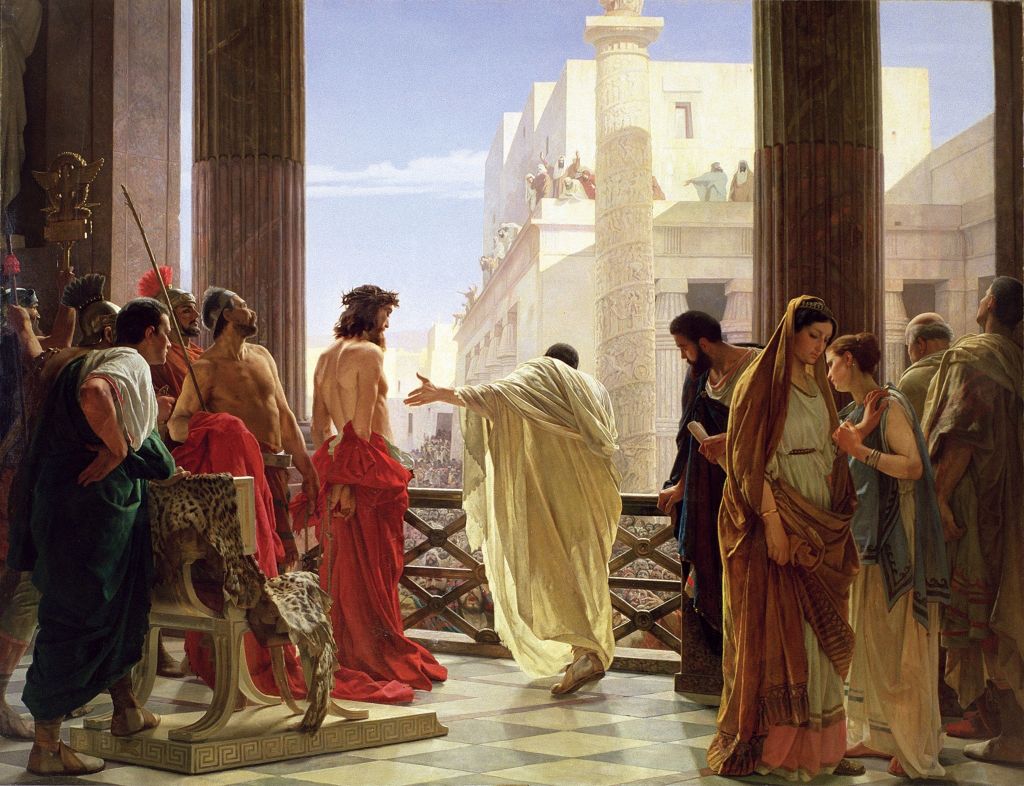
The central figure of the Christian Scriptures is quite clearly Jesus of Nazareth. This ‘person,’ if you will; the acclaimed Jewish messiah—or a man who got killed for his troubles—would go on to fundamentally change the world in virtually every aspect, whether his claims were ‘true,’ is not up for me to decide, but you. His ending, the crucifixion upon Calvary, is one of the most well-known stories (cf., Wisdom 2:20). And in the grand scheme of his passion, every character, scene, and story on the way to His yielding, is poised with religious symbolism, meaning, and endless ‘revelation’ (Matthew 27:50; cf. John 19:30).
In the grand scheme, Peter denies, Judas betrays, Barabbas laughs, Pilate equivocates, and his own cry for his blood to drip (Matthew 26:14-15; Mark 15:11; Mark 15:12; Luke 22:60). Yet, amid all this turmoil, there is a single character whose small voice is often skipped over as she speaks from the shadows of her ‘role’ as a wife—
While he was sitting on the judgment seat, his wife sent word to him, “Have nothing to do with that innocent man, for today I have suffered a great deal because of a dream about him.”(NRSV)
Καθημένου δὲ αὐτοῦ ἐπὶ τοῦ βήματοςἀπέστειλεν πρὸς αὐτὸν ἡ γυνὴ αὐτοῦ λέγουσα,Μηδὲν σοὶ καὶ τῷ δικαίῳ ἐκείνῳ, πολλὰ γὰρἔπαθον σήμερον κατ’ ὄναρ δι’ αὐτόν (NA28)
Gospel of Matthew 27:19
The woman who utters these words in Matthew 27:19, just so happens to be the wife of Pontius Pilate, the Roman governor of Judea, who presided over the trial of Jesus of Nazareth. His wife utters only one single line in the entire Christian Scriptures; a short shimmer of spiritual, moral, and literary weight. In the canonical Christian Scriptures, her single appearance in Matthew 27:19, during Jesus’ trial, is short and blunt. Her almost ‘random’ advice to her husband seems urgent and interruptive and counterpoints his own calling for his blood. She very clearly warned her husband not to be involved in the execution of this ‘just man.’ Her reasoning is personal yet mysterious: she has suffered in a dream because of him. The Greek word used here for “suffered” in Matthew 27:19 is ἔπαθον, épathon, meaning “I suffered.” Although textual variants are common. Some Byzantine manuscripts (such as the Textus Receptus) use ἐβασανίσθην; ebasanisthēn, instead, which implies torment, testing, or even torture; it indicates a deeply distressing experience that she happened to have while sleeping. Codex Sinaiticus (ℵ, 01) Codex Vaticanus (B, 03) both use ἔπαθον
Her brief, unnamed appearance adds a rupture in the story (an intercalation) that completely covers the scene with flowing water that is profound in weight but clear in visibility. The brief appearance is almost always skipped over by the Christian, it seems, being read in tandem with other verses. Pastors, preachers, or even the ‘Christian enterprise’ as a whole, do not give the verse its time, as I see it.
Thus, the question of why this is—why this woman and her singular line of case is seemingly skipped over, additionally seems to be tied to the question that the verse attempts to answer.
For a start to this rather wretched commentary produced by an even more wretched 21-year-old: let’s set the stage.
At this point in the narrative of the New Testament, we are in the penultimate stage of the story of Jesus of Nazareth—for he is standing before his trial. Jesus, after being arrested by Jewish authorities, finds himself on trial for blasphemy, being presented to Pilate as a political threat instead of ‘Jesus’, for instead of blasphemy, it is presented as an accusation of claiming kingship, which would be quite a serious offense in Roman eyes (Matthew 27:11-12). The crowd is gathered, and Pilate is wavering in his indecision. For he finds no fault in the man who stands before him, yet amid the pressure to maintain public order, preserve Roman control, and avoid an uprising, the strangely odd situation seems to be weighing heavily on him. Something about the man who stands before him has fixated Pilate on such a decision that his mind will have to make (cf. John 19:4; Matthew 27:24). Particularly when the city is filled with pilgrims for Passover, the decisions he makes, are more than simple politics or the justice of Man (Matthew 27:23; Matthew 27:24). At this very moment of indecision, while Pilate is quite literally sitting on the judgment seat (a vastly loaded phrase; a precursor to the Chair of St. Peter), his wife sends him a message about the man who stand before him—prompted by a dream (Matthew 27:19).
He now has a decision to make, and his decision may seem simple on paper, but the simplicity oddly weighs on Pilate. Does he send a just man to death (cf. John 18:38 Mark 15:14)? The garment of political order with Pilate seems to be ripping, with an odd warning from whom he loves most that justice and innocence hang in the balance, and that Pilate’s uneasiness seemed to be correct—for something is different about the man who stand before him—and that dreams, even if they are however dismissed, may just so happen to carry ‘divine consequence.’ Why is he sending a just man to death? For what wrong has he committed? For Pilate has found that the 99 sheep, seemingly, are more convincing than the one.
We will continue the story of Pilate’s actions, and his actions regarding his wife’s comments, further in this discourse; for now, this woman requires closer examination. It seems we must lift this woman’s veil and see what her dream says about the female gender, its relationship to the ‘law,’ and to the divinity of the Christ figure itself.
This woman and her single line create more questions than answers, and by doing so, has intrigued me, a 21-year-old with no formal theological training. Who is this woman who dreams of the ‘Christ’ while the rest of the Holy Land conspires to crucify Him? Why does Matthew’s account not elaborate on such a dream? Why is her warning placed in the mouth of a Gentile, most likely a Roman woman, otherwise completely absent from the scene of the Christians’ salvation history? What does her appearance suggest about conscience, gender, and the unseen workings of providence within power? These questions are rather profound and complex, and to answer them in a simple discourse (i.e., the following) is a wretched task, but I will attempt to follow through.
To begin with, the historical context surrounding Pilate’s wife’s identity remains ambiguous. The canonical Gospels, those in the Christian scriptures, do not name her, but later, Christian tradition seeks to fill in her name, whether for gain or for truth, remains unknown (cf. Gnosticism; some may say Catholicism as well).
These later Christian traditions of the women are written much later than Christ. For example, the Gospel of Nicodemus (Ευαγγέλιο του Νικοδήμου), also known in some circles as the Acts of Pilate (Πράξεις Πιλάτου), is an apocryphal text dating to the 4th, possibly 5th century, though it may incorporate earlier traditions, and is one of the leading ‘source’ documents on this woman (Yamauchi, 1979). Additionally, the text expands on the passion narrative, Jesus’ descent into Hell, and then further develops the account of the resurrection. In it, the wife of Pilate is named Claudia Procula (James, 1924). These earlier traditions are often considered to have originated from the document known as the Acts of Paul (Πράξεις Παύλου), which should not be confused with the Acts of Paul and Thecla (Πράξεις Παύλου και Θέκλας). Yet, a simple reading of the text will find no mention of Claudia or her baptism (Jones, 2007).
In Eastern Orthodoxy, she is venerated as a saint; her feast day is October 27th (OCA, n.d.). In the East, she is portrayed as a righteous gentile who, through her dream and revelation, opposed the crucifixion of Christ (OCA, n.d.). With this in mind, tradition says she would later convert to Christianity (OCA, n.d.). The same thought process was not applied in the Latin West, and she is not venerated as a saint in the Catholic Church or any following Protestant denominations that venerate the sainthood (e.g., Lutheran and Anglican/Episcopal).For this discourse, she will remain unnamed due to the writer of the Gospel of Matthew not mentioning a name.
The Church fathers do speak of this woman, rarely; for this, I have found two accounts — one from the East and one from the West. Both kept it writing by St. Thomas Aquinas.
In the East, St John Chrysostom writes,
Then is added something else which alone was enough to deter all from putting Him to death; When we he as set on the judgment seat, his wife sent unto him, saying, Have thou nothing to do with that just man. For joined with the proof afforded by the events themselves, a dream was no light confirmation. But why did Pilate himself not see this vision? Because his wife was more worthy; or because if Pilate had seen it, he would not have had equal credit, or perhaps would not have told it; wherefore it is provided by God that his wife should see it, and thus it be made manifest to all. And she not merely sees it, but suffers many things because of him, so that sympathy with his wife would make the husband more slack to put Him to death. And the time agreed well, for it was the same night that she saw it.
S. John Chrysostom, Abp. of Constantinople, A.D. 398. Ed. Ben Par. 1718–38. Doucmented by, Aquinas, T. (n.d.). Catena Aurea: Commentary on the Gospel of Matthew. In St. John Chrysostom, Homily 85 on the Gospel of Matthew.
St. Jerome, in the Western tradition of thought, writes,
Observe also that visions are often vouchsafed by God to the Gentiles, and that the confession of Pilate and his wife that the Lord was innocent is a testimony of the Gentile people.
Documented by Aquinas, T. (n.d.). Catena Aurea: Commentary on the Gospel of Matthew. In St. Jerome, Commentary on Matthew 27. Retrieved April 25, 2025,
As I previously mentioned in this discussion, there are differences in the East and West regarding this woman. There are two distinct yet complementary thoughts and reflections on her role in the Passion narrative. St. John Chrysostom emphasizes the death of the ‘symbol’ more; Pilate’s wife receives a divine vision, which he then argues was intended to prevent Pilate from condemning Christ, suggesting that God revealed this to Pilate’s wife because God deemed her more worthy to receive (instead of Pilate himself). This, in turn, is an argument for why she converted to Christianity, at least in the East (n.b., the contrast with Calvin’s doctrine of unconditional election; of interest to the reader). Chrysostom implies that divine ‘intervention’ occurred not for the sake of the justice of Christ, but in a way to demonstrate that God is demonstrating his sovereignty in the events that are currently unfolding—even through a seemingly minor character. For the figure and idea of Christ is not to come as just the savior of the Jews, but of Gentiles as well—God can work through man and is not limited to man’s creed. On the other hand, St. Jerome highlights the broader theological themes as they pertain to Christ’s innocence. He points to the fact that Gentile women received a ‘revelation,’ echoing the broader Gentile acceptance of Christ’s divinity (and innocence). In a similar way to Chrysostom, Jerome argues that this vision given to Pilate’s wife serves as a revelation from the divine, indicating the spread of God to the Gentiles, not just Israel. Jerome is more restrained in tone, seemingly skeptical of such personal revelation, a topic of concern in the West to this day (i.e., Classical Protestantism, and Roman Catholicism; Evangelicals tend to put more emphasis on personal relationship with God, and revelation from God; Pentecostal, Baptist, etc.).
While the implications of Pilate’s wife drive from previous Christian thought to today, and my personal comment on the matter, it is also just as necessary to step back in time, and consider the historical and cultural backdrop of Pilate and his wife for a better, and correct understanding of the scene, moment, and verse. The real-life individuals involved are, quite simply, the Roman governor and his wife; yet, these individuals were also embedded in a complex web of imperial authority and legal customs, all while dealing with cultural tensions. Thus, one must understand the political role and why his wife is there in the first place. Before any theoretical or symbolic commentary can be conducted or drawn at length, an examination of the actual historical setting of this Roman couple must be accomplished.
Pilate, her husband, served as the Roman prefect of Judea from AD 26 to 36 under the reign of Emperor Tiberius (Bond, 1998; cf. Matthew 27:2; “ἡγεμών” – “governor”). Historical accounts from around that time, such as the writings of Flavius Josephus, depict the man as ruthless, clashed with Jewish religion, and proved to be cruel (Bond, 1998). Josephus writes in AD 93-94,
Pilate was the first who brought those images to Jerusalem… he gave a signal to the soldiers to encompass them… and threatened that their punishment should be no less than immediate death… But they threw themselves upon the ground, and laid their necks bare… upon which Pilate was deeply affected… and presently commanded the images to be carried back”
Josephus, Antiquities of the Jews 18.3.1
It is of note for context and general knowledge that Roman legal tradition almost always discourages governors from bringing their wives to where they are, yet exceptions existed; this is one of those exceptions (Hallet, 1991). It’s this unusual historical detail that has garnered much of my attention.
It just seems odd that Pilate’s wife was even present in Judea in the first place, let alone the writer of the Gospel of Matthew, (1st) including/knowing she said this, (2nd) viewing her role more than just incidental. With this idea of both Pilate being a ruthless ruler, and his wife being there, the narrative then shifts dramatically inward, to a moment of private revelation amid a very public trial. Matthew’s Gospel records a single, cryptic intervention by her, breaking the flow of the trial and introducing the divinity of Christ into Pilate’s mind amid the machinery of Roman justice. For context, the Gospels often use ‘dreams’ as a way to communicate with the divine (e.g., Joseph in Matthew 1–2). However, in this context, it is unusual, as she stands out—she is a Gentile woman receiving it, an unlikely prophetic figure in historical terms.
The narrative in which Pilate’s wife appears is a story we all seemingly know but don’t often realize: a trial drama. Jesus of Nazareth is handed over by the Jewish authorities, tried under charges, and sentenced by a reluctant governor who seemingly cannot find fault in the man, which would be an excellent show for Netflix (cf. Matthew 27:1–2, Luke 23:2; Matthew 27:24). The courtroom genre blends Christ with an apocalyptic vibe, and Pilate’s wife emerges as a character in a legal-theological drama, voicing an interruption. In terms of the context of the Hebrew scriptures, she mirrors figures like Pharaoh’s dreams in Genesis 41 or Nebuchadnezzar’s in Daniel 2; dreams from God disrupt political power.
Yet her voice in this ‘new’ narrative is not only prophetic but tragically ineffective. Unlike Joseph, who interprets dreams to change the course of different events and does it successfully, her warning is flatly ignored—a window that is never opened. Her warning, or intervention, does not sway the outcome, even slightly. Instead, it amplifies the ‘choke’ in Pilate’s decision, for there is simply a lot of moral ambiguity. He famously “washes his hands” off the case (cf. Matthew 27:24). Still, she warns him to stand as proper judgment against cowardice, for Pilate could not find anything wrong with the man ( Matthew 27:24). She openly invites him to disengage his mentality. Still, Pilate remains entangled—his political fears, particularly during Passover and a Jewish Mob screaming for the blood of this man, outweigh her spiritual caution.
Her words— for today I have suffered a great deal because of a dream about him—are not in a law that Pilate is forgetting, or even a rational argument, but in personal spiritual experience—that Pilate, or us, can’t prove as ‘valid’ or ‘real’ because it is—purely personal. While often deeply meaningful to the individual, religious experiences or personal revelation are wildly complex(cf. the work of William James). It is significant in the challenge of theological discussion and spiritual practice, due to its personal subjectivity. This nature of it means it cannot be universally verified, critiqued, or measured against a standard of religious testing (i.e., what is ‘valid’ or not). It is not just problematic in particular practices of one tradition, but virtually in all. For example, those traditions that emphasize sola scriptura (or prima scriptura) often insist that divine truth is meditated solely through scripture—yet will then have personal experiences—dreams, visions, or inner convictions—that are then elevated to the standard of scripture, which adds a risk of undermining the authroty of the Scripture in the first place. It creates a scene where one’s internal feelings of what their religion is no longer based on what Scripture says, but on what is ‘said’ in one’s head; feeling is treated the same as written Word (cf. John 1:1). This leads to absolute chaos, and theoigical confusion, a tension between not being able to determine what is ‘correct’ because you now have two sides of a coin that now feel ‘correct ’ but are contradictory to each other. Think of a situation like this:
Person A: ‘Yeah, I know Jesus is real. I’ve always believed in God. I’m not out here hating Him or anything. I’m just trying to live my life, stay in my lane. It’s not like I’m anti-religion.’
Person B: ‘Maybe you’re not against Him—but are you with Him? Belief without surrender isn’t faith, it’s convenience. I had this overwhelming sense last night—you’re standing at a crossroads, and acting like you can sit down in the middle.’
Person A: ‘You’re being dramatic. I haven’t done anything wrong. I’m not out here killing people or denying Christ or something.’
Person B: ‘It’s not about blatant rebellion. It’s about the quiet refusal to respond. You’ve heard the truth. You know it matters. But you’re acting like staying neutral excuses you from action.’
Person A: ‘Look, I’m not the type to get all religious. God knows my heart. I’m spiritual in my own way.’
Person B: “But if you know the truth and won’t follow it, then your silence is a decision. You think you’re avoiding the fight—but you’ve already chosen a side by walking away. The invitation is in front of you. And pretending you’re not involved won’t make it disappear.”
A crude example, but one that most certainly mirrors the ambiguity and spiritual urgency in Matthew 27:19, albeit in a contemporary way. Like Pilate’s wife, Person B delivers a message of warning, one that is a grounded call to act ‘rightly’ in their eyes. Their insight does not come from a legal or institutional authority, but rather from a deeply personal and subjective experience (i.e., a sense, a dream, a nudge). Just as his wife urges him not to be in the middle ground and recognize injustice before him to do a dream of suffering, so too does Person B urge Person A, not to remain passive, when it’s supposedly ‘true.’
In both cases, the recipient of the warning—Pilate and Person A—is caught in a moment of decision, but as is common in the ‘scientific’ and ‘modern’ world, both are plagued by hesitation and self-justification. The pull of social or political pressure, in the case of Pilate, is strong enough to the point of deciding on fate without. Pilate is bound by Roman law, and therefore the act of public execution during a fear of a riot with the masses during Passover, forces him to choose the path of least resistance, washing him self clean of the situation. In a similar vein, Person A rationalizes the neutrality, insisting on good intentions in their life, and minimizing their need for commitment. It’s comical—they to ‘wash their hands’ of the choice they need to make, before their emotional proclamations force them to say that ‘God knows my heart,’ which, in all reality, is most likely false and simply individualistic tendencies taking over the human consciousness of decision making. For just as Pilate had to choose whether to heed his wife’s plea, so every person must decide what to do with truth once it is revealed—however it is revealed.
I mentioned before that revelation is problematic in all traditions of Christianity, not just those who follow sola scriptura.
Take Catholics.
One of the best examples as it pertains to that tradition of Apostolic origin is that of Marian apparition (i.e., supernatural occurrences of the Virgin Mary back on Earth). More specifically is one such supposed Marian apparition: Medjugorje.
Beginning in 1981, six children in the small village of Medjugorje, Bosnia and Herzegovina, claimed that the Blessed Virgin Mary was appearing to them regularly, delivering messages of peace, conversion, prayer, and fasting (Laurentin & Rupčić, 1984). Now that is an insane way for me to put that, here, I will give you a selection of what the Virgin Mary has supposedly said at these apparitions.
Key Warnings from the Virgin Mary at Medjugorje (as reported by the visionaries):
- Call to Conversion—Mary reportedly emphasizes urgent conversion of hearts, repentance. She says humanity is turning away from God.
- Impending Chastisements—According to the visionaries, Mary has entrusted each of them with ten secrets—some personal, others global. Three of these secrets are said to be warnings for the world.
- A Permanent Sign—One of the secrets involves a permanent, miraculous sign that will appear on Apparition Hill in Medjugorje as a visible proof of her presence. It will be undeniable and not man-made.
- A Time of Great Trials—There is mention of trials for the Church and the world, possibly including natural disasters, suffering, and tribulation if humanity does not convert.
- Triumph of Her Immaculate Heart—Mary assures that, ultimately, her Immaculate Heart will triumph, echoing the Fatima message. She points to peace and Christ’s reign in hearts as the final goal.
“What I started in Fatima, I will finish in Medjugorje. My heart will triumph.” — Alleged message from the Virgin Mary
These revelations or appearances of Our Lady were all private and concealed just to the group of children.
Since it was children, the area quickly attracted global attention and millions of pilgrims. And yet, despite devotion to the apparition continuing, and many people seeing spiritual fruit from such devotion, the Catholic Church has never formally approved the apparitions as authentic in the same definitive way it has approved others (Vatican News, 2019). Even the former Holy Father, Pope Francis, found himself commenting that while people who go to Medjugorje “find God,” he remains personally “skeptical” of the alleged ongoing nature of the visions (Winfield, 2017). The Vatican permitted official pilgrimages beginning in 2019, but the approval should not be taken as an endorsement of the supernatural origin of the apparitions themselves (Vatican News, 2019).
The Medjugorje situation is wickedly complex, and deserves a discourse of its own, although I tried to condense a massive spiritual concern in Catholicism into a chewable section for this piece, I have left out details through no fault of mine, but out of respect for the reader. See, what Medjugorje reveals is a deep unease within Catholicism (more specifically, Apostolic Christianity) about how to handle claims of personal revelation.
Though Catholics do not subscribe to sola scriptura, the deposit of faith—Scripture and Sacred Tradition—still holds supreme authority. Private revelations, no matter how profound or stirring, “do not belong… to the deposit of faith” (Catechism of the Catholic Church [CCC], 1997, §67). This includes Marian apparitions; you are not ‘required’ to believe in them, even if the Vatican approves them. Personal revelation, such as those Marian Apparitions that are personal, may illuminate or inspire, but they can never bind the conscience of the faithful in the same way public revelation does. They may be tolerated, even encouraged, if they lead souls closer to Christ—but they can also be misleading or false (CCC, 1997, §67).
Just like the dream of Pilate’s wife, Medjugorje poses a spiritual invitation not grounded in law or doctrinal authority, but instead, in the wildly subjective realm of mystical experience (personal revelation). Thus, just like Pilate, the (C)hurch must choose how to respond to one’s personal revelation: ignore, approve, condemn, or wait. What do you (or the Church) do with a dream that can’t be verified? With a message you feel, but cannot prove? Medjugorje is a modern echo of Matt. 27:19.
Only time will tell whether this ‘apparition’ is true; the same could be said of the wife of Pilate.
Now, if you have made it through around 4000 words on a very random verse, I thank you. Pilate’s wife, albeit with a short account, is a subtle moment in the Passion narrative, an obtuse rock among a flowing river. Her line is not a footnote, but a rupture. And it’s because it cannot be verified or even rationalized—it simply just causes contemplation and thought, like most of the Gospel does. In this single verse—Matthew 27:19—we confront a perennial human and theological question: What do we do with what we cannot explain? Which, in simplest terms, is what the story of Jesus of Nazareth tries to answer—I guess.
She forced me to grapple with something that troubles me with religion and revelation—how can I believe what I can’t see, touch, or feel? I guess it would be easier for me, perhaps, to dismiss such things in all their quantity—to side with law, with clarity, with reason. For I have been struggling with the entire idea of Christianity, with most of my time ‘believing’ in it.
But the dream remains.
It is a verse that stains the pages of my Douay-Reims Bible, with a quiet warning that I cannot help but notice.
And here lies the irony: in a story about truth on trial, it is the voice that is least credited-the unnamed Gentile wife of a Roman official—that comes closest to proclaiming Christ’s innocence without even the slightest of hesitation (albeit, it’s not recorded if she does). Her dream was disregarded. But the writer of the Gospel of Matthew preserved her words, for seemingly no reason—a question left unanswered.
To end, it’s rather comical, we, the reader, are left where Pilate sat: upon the seat of judgment. Not over Christ, but over truth. Over dreams. Over revelation. And the haunting question is not simply, ‘What will you do with this Jesus person?’ but also, ‘What will you do with the warnings that come without proof?’
Whether this woman dreamed of Christ is not something I claim to know, but I will tell you this: I have read the verse, and I have heard of this woman’s dream. And I guess, I am left with this,
Dreams may not be doctrine, but they are not always silent, and sometimes, the most ignored words will echo the loudest in eternity.
So take it as you will.
– –
Colin
Bibliography
Augustine. On Dreams. In Letters, translated by Sister Wilfrid Parsons. Washington, D.C.: Catholic University of America Press, 1953.
Bond, Helen K. Pontius Pilate in History and Interpretation. Cambridge: Cambridge University Press, 1998.
Catechism of the Catholic Church. (1997). Catechism of the Catholic Church (2nd ed.). Libreria Editrice Vaticana. https://www.vatican.va/archive/ENG0015/_INDEX.HTM
Pontius Pilate in History and Interpretation, 49–93. Society for New Testament Studies Monograph Series. Cambridge: Cambridge University Press, 1998.
Hallett, Judith P. “Female Participation in Roman Military Settlements.” In Women’s History and Ancient History, edited by Sarah B. Pomeroy, 74–96. Chapel Hill: University of North Carolina Press, 1991.
James, M. R., trans. The Gospel of Nicodemus. In The Apocryphal New Testament, 133–147. Oxford: Clarendon Press, 1924.
Jones, Timothy Paul (2007). Misquoting Truth. InterVarsity Press. p. 167..
Nestle-Aland. Novum Testamentum Graece. 28th ed. Stuttgart: Deutsche Bibelgesellschaft, 2012.
Laurentin, R., & Rupčić, T. (1984). Is the Virgin Mary appearing at Medjugorje? (F. M. Larkin, Trans.). St. Paul Editions.
Origen. Homilies on Matthew 35.6. In Origen: Homilies on Luke, Fragments on Luke, translated by Joseph T. Lienhard. Washington, D.C.: Catholic University of America Press, 1996.
Orthodox Church in America. “Righteous Claudia Procula.” Lives of the Saints. Accessed April 11, 2025.
Yamauchi, E. M. (1979). “Apocryphal Gospels”. In Bromiley, G. W. (ed.). The International Standard Bible Encyclopedia. Vol. 1. William B. Eerdmans. p. 183. ISBN 0-8028-8161-0
Vatican News. (2019, May 12). Pope authorizes official pilgrimages to Medjugorje. https://www.vaticannews.va/en/pope/news/2019-05/medjugorje-pilgrimages-authorized-pope-francis.html
Winfield, N. (2017, May 13). Pope skeptical of Medjugorje visions, but OKs pilgrimages. Associated Press. https://apnews.com/article/dc4e47eec7304b7ba4e6d0b417389d17
 Colin C. Caso
Leave a comment